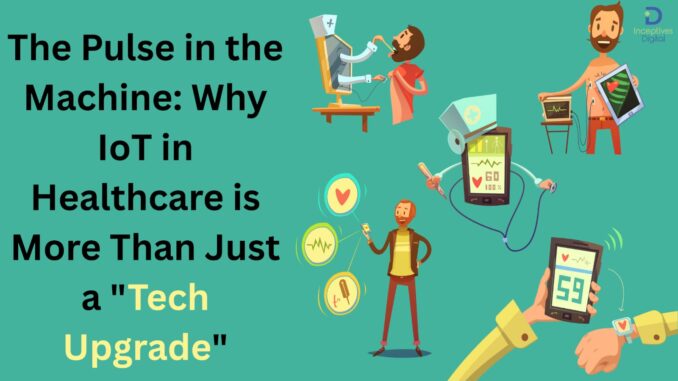
Let’s be real for a minute. Most of us hear the word “healthcare,” and we immediately think of fluorescent lights, that weird, sterile smell, and the inevitable mountain of paperwork that follows a ten-minute check-up. It feels mechanical. But there’s a quiet, digital hum starting to change that vibe. We’re talking about IoT in Healthcare, and honestly? It’s about time.
It isn’t just about sticking a sensor on a patient and calling it a day. It’s about creating a living, breathing network. To pull this off, savvy medical groups are hunting for an IoT app development company that actually understands how to make a pulse monitor talk to a smartphone without it feeling like a clunky science project. This isn’t just “tech for tech’s sake.” It’s about keeping people out of hospital beds and in their own living rooms.
1. The Death of “Reactive” Medicine
Historically, the doctor-patient relationship has been a bit like a game of telephone. You feel a weird thumping in your chest on a Tuesday, you finally see a doctor on a Friday, and by then, you’re trying to describe a feeling that’s already gone. It’s guesswork.
With IoT in Healthcare, that guesswork is basically dead. Imagine a world where your cardiologist gets a ping the second your heart skips a beat—not three days later. That’s the “Internet of Medical Things” (IoMT) in a nutshell. It shifts the entire medical industry from “Wait and see” to “Detect and act.” It’s a massive psychological shift for doctors, too. They’re moving from being “firefighters” putting out medical blazes to “guards” watching the perimeter 24/7.
2. Where the Rubber Meets the Road: Real-World Scenarios
I’m not interested in the “theoretical” stuff. Let’s talk about what’s happening in actual wards and bedrooms right now.
The “Smart” Inhaler: A Breath of Fresh Data
For anyone with chronic asthma, an inhaler is a lifeline. But standard inhalers are “dumb”—they don’t record anything. IoT-enabled inhalers, however, track exactly when and where you take a puff.
- The Human Benefit: If a kid is using their rescue inhaler five times a day at school, the parents get an alert.
- The Big Picture: Researchers can aggregate that GPS data to find “asthma hotspots” in cities. Maybe there’s a spike in pollution on a specific street corner? The inhaler tells us. It’s a tiny device doing big-scale epidemiology.
Asset Tracking (Because Hospitals are Huge)
You’d be shocked—or maybe horrified—to know how many hours nurses spend just looking for stuff. Where’s the nearest wheelchair? Who took the IV pump? In a massive, sprawling hospital, “losing” equipment is a multi-million dollar headache. By tagging everything with low-power IoT sensors, a nurse can look at a tablet and see exactly where the nearest defibrillator is. In an emergency, those thirty seconds they save aren’t just a “metric.” They’re the difference between a recovery and a tragedy.
3. Why This Isn’t Just “Another App”
Look, anyone can build a basic app. But building for the medical world? That’s a different beast entirely. When we talk about an IoT app development company‘s role, we’re talking about three pillars that usually break “normal” software:
- The “Nuclear” Data Problem: Medical data isn’t just private; it’s radioactive. If it leaks, lives are ruined. The encryption layers in these devices have to be military-grade, yet they still have to be easy enough for an 80-year-old patient to use. That’s a hard needle to thread.
- Zero-Latency Reality: If an IoT-enabled bed detects a patient falling out, that alert can’t sit in a queue. It needs to hit the nurse’s station now.
- The Battery Life Struggle: You can’t ask a heart patient to take off their monitor every four hours to charge it. The engineering behind low-power, “always-on” medical sensors is genuinely mind-blowing.
4. The “Dark Side” We Need to Talk About
I’d be lying if I said this was all sunshine and rainbows. Two major roadblocks keep hospital boards up at night: Security and Data Fatigue.
First, security. Every “smart” thermometer is a back door for a hacker. We’ve already seen hospitals held for ransom. The more we connect, the more we expose. It’s a trade-off we’re still figuring out.
Second, “Alert Fatigue.” If a doctor’s phone pings every time one of their 500 patients has a slightly elevated heart rate because they’re watching a thriller on Netflix, the doctor is going to start ignoring the pings. The future of IoT in Healthcare isn’t just about collecting more data—it’s about knowing which data to ignore. We need better filters, not more noise.
5. Wrapping It Up: The 2026 Outlook
We’re heading toward a future where the “hospital” isn’t a building you go to; it’s a service that follows you around. Your bathroom mirror might eventually check your skin for weird moles. Your “smart” toilet might analyze your waste for early markers of disease before you even feel a symptom.
The goal of all this tech isn’t to make medicine feel more robotic. Ironically, it’s to make it more human. If the machines handle the data entry and the constant monitoring, the human doctor finally has time to actually sit down, look you in the eye, and talk to you.
We’re finally putting the “care” back in healthcare, powered by a whole lot of invisible, connected sensors. And frankly? It’s about time.
A Quick Note on the Technicals
Building out this kind of ecosystem requires a deep dive into edge computing and secure cloud gateways. If you’re looking to scale a medical practice, don’t just buy off-the-shelf gadgets. Look for a partner who understands the specific “flavor” of IoT in Healthcare—one who prioritizes patient trust over flashy features.

Leave a Reply