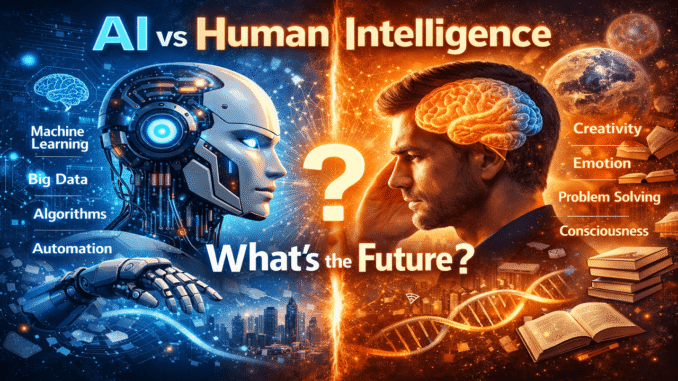
Something big is happening. Machines are learning to write, paint, diagnose diseases, and drive cars. They beat world champions at chess. They write code and hold conversations that feel surprisingly human. For many people, this raises one simple question: What does this mean for us?
The debate around artificial intelligence (AI) and human intelligence is no longer just for scientists. It touches everyone. It affects how we work, how we learn, and what we think it means to be human.
This article takes a calm, clear look at what AI can and cannot do and what the future might look like for both humans and machines.
What is AI, exactly?
AI is software that can learn from data and use that learning to make decisions or predictions. It is not magic. It is math very clever math.
Modern AI systems, like ChatGPT or Google’s Gemini, are trained on huge amounts of text. They learn patterns in language. They get good at predicting what word comes next. Over time, that ability lets them write essays, answer questions, and even hold debates.
But here’s the key thing: AI does not understand it predicts. It doesn’t know what words mean the way you do. It has never felt cold, loved a friend, or feared failure. It processes text and produces text. That gap matters a lot.
Where AI is already winning
There are some things AI does extremely well. Better than almost any human.
Speed and scale. AI can read and summarise 10,000 documents in seconds. No human team can match that. In medicine, AI tools can scan X-rays and spot signs of cancer faster than most radiologists. In law, AI can search through thousands of legal cases overnight.
Pattern recognition. AI is brilliant at finding patterns in huge datasets. It powers fraud detection at banks, traffic prediction on Google Maps, and recommendation engines on Netflix and Spotify.
Consistency. Humans get tired. We get emotional. We make mistakes when we’re stressed. AI doesn’t have bad days. It performs the same way at 3 a.m. on a Sunday as it does at 9 a.m. on a Monday.
Memory. AI can store and access vast amounts of information instantly. A doctor has to remember thousands of drug interactions. An AI can look all of them up in milliseconds.
“AI doesn’t understand — it predicts. It has never felt cold, loved a friend, or feared failure.”
Where humans still lead
Despite all that power, AI has some serious blind spots.
Common sense. Humans have something AI struggles with deeply — common sense. You know that if you drop a glass, it will break. You know that a child crying in a supermarket might be lost. These seem obvious to us because we’ve lived in the world. AI has only read about it.
Emotion and empathy. AI can simulate empathy by using words that sound caring. But it doesn’t actually feel anything. A grieving person needs more than the right words. They need presence, warmth, and real understanding. That’s a human skill.
Creativity with meaning. AI can produce art, music, and stories. But most experts agree it recombines existing ideas rather than truly inventing new ones. Human creativity often comes from pain, joy, curiosity, and lived experience. That’s very hard to replicate.
Ethics and judgment. When something goes wrong, someone needs to decide what’s right. AI can give you options. But the weight of a moral decision — the kind that keeps you up at night — is a human burden. And that burden requires human judgment.
Physical intelligence. It’s surprisingly hard to build a robot that can fold laundry or navigate a cluttered kitchen. Humans do this effortlessly. Our bodies and brains work together in complex ways that AI-driven robots still can’t fully match.
| AI Strengths | Human Strengths |
| • Speed and scale at any hour
• Finding patterns in huge datasets • Perfect memory and recall • Consistent, tireless performance • Processing many tasks at once |
• Common sense and lived experience
• Genuine emotion and empathy • Moral reasoning under pressure • Original creative thought • Physical dexterity and adaptability |
The jobs question
The question most people are really asking is: Will AI take my job?
The honest answer is: some jobs, yes. But it’s more complicated than that.
History gives us useful clues. When the printing press arrived, scribes lost work. When cars replaced horses, stable workers had to change careers. When ATMs arrived, people feared bank tellers would disappear. Instead, bank teller jobs actually grew — because branches became cheaper to run, so banks opened more of them.
Technology changes the shape of work. It rarely eliminates work entirely.
AI is already replacing parts of some jobs. It handles customer service chats, writes first drafts of articles, generates legal boilerplate, and codes routine functions. People who do only those tasks in those fields will feel the pressure.
But new jobs are also appearing. Prompt engineers help businesses communicate with AI systems. AI auditors check AI outputs for bias and errors. Data trainers help AI systems learn better. These roles didn’t exist five years ago.
The pattern that matters: Jobs that involve repetitive, rule-based tasks are most at risk. Jobs that require creativity, human connection, complex judgment, or physical skill are much harder to automate. If your work makes people feel seen and valued, AI is unlikely to replace you.
The risks we need to take seriously
It would be dishonest to only talk about opportunity. AI comes with real risks.
Misinformation at scale. AI can generate fake news, fake photos, and fake videos (called deepfakes) faster than humans can fact-check them. This is already happening. Elections, reputations, and public trust are all at risk.
Bias baked in. AI learns from human data. Human data contains human prejudice — racism, sexism, and other biases. If we’re not careful, AI systems can multiply these biases and apply them at scale.
Privacy and surveillance. AI makes it much easier to watch people. Facial recognition systems can identify you in a crowd. Algorithms can predict your behaviour, your mood, even your politics. Who controls that data — and what they do with it — matters enormously.
Concentration of power. Right now, the most powerful AI systems are built by a handful of companies in a handful of countries. If AI becomes as important as electricity, that concentration of power raises serious questions about fairness, access, and democratic accountability.
Existential risk. Some of the world’s most serious scientists worry about longer-term risks. If AI systems become powerful enough to pursue their own goals, and if those goals don’t align with human values, the consequences could be severe. This is taken seriously by people like Geoffrey Hinton and Yoshua Bengio, two of the pioneers who helped build modern AI.
What makes humans irreplaceable?
Let’s return to the deeper question underneath all of this. What makes human intelligence special?
Humans are not just information processors. We are meaning-makers. We ask why, not just how. We build cultures, tell stories, fall in love, grieve our losses, and search for purpose. These are not bugs in our system. They are the point of being human.
AI can simulate many of these things. A chatbot can say something that sounds comforting. An algorithm can generate a story that feels moving. But simulation is not the same as the real thing. When you are truly seen by another human — understood, cared for, held — no AI can replicate that.
Our ability to adapt, to question, to disagree, to imagine futures that don’t yet exist — these things are not limitations to be optimised away. They are what make us capable of building a better world.
“Humans are not just information processors. We are meaning-makers. We ask why, not just how.”
The most likely future: partnership
The framing of “AI vs humans” is useful for debate, but it probably isn’t how the future will look.
The most likely scenario is that AI becomes a powerful tool — one that the best professionals in every field learn to use well. Doctors who use AI to catch what they might miss. Lawyers who use AI to research faster. Teachers who use AI to personalise lessons. Writers who use AI to get past a blank page.
The people who will thrive are not necessarily the most technically brilliant. They are the people who are curious, adaptable, and deeply human in how they work — people who can use AI as a tool while bringing something AI cannot: judgment, warmth, and genuine understanding.
This requires education systems that teach critical thinking, not just facts. It requires policies that spread the benefits of AI broadly, not just to the wealthy. And it requires us to stay intentional about the values we want AI to serve.
Final thought
AI is one of the most powerful technologies ever created. It will change how we work, how we learn, and how we understand ourselves. That is not a small thing.
But it does not change the fundamental question: What do we want our lives and our societies to be? That question belongs to us. Answering it well — together, thoughtfully, with care for those left behind — is the most human task of all.
Leave a Reply