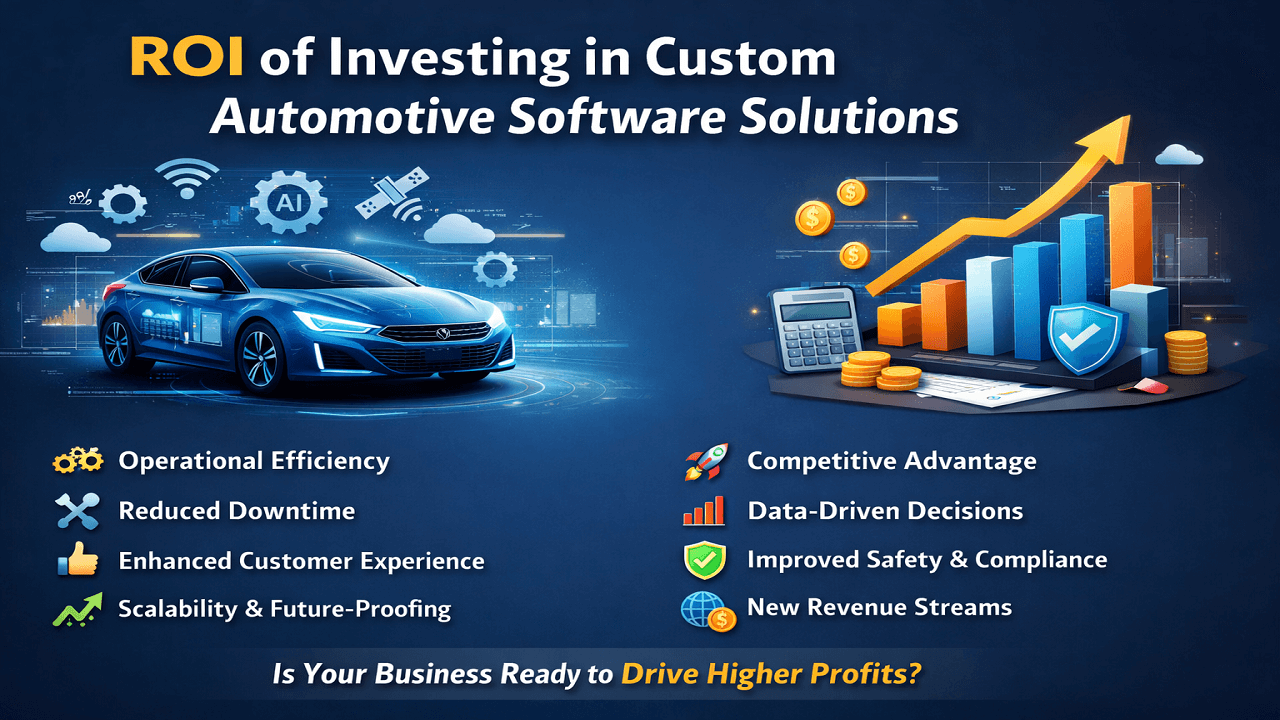
The automotive industry stands at a critical technological crossroads. As vehicles evolve from mechanical machines into sophisticated software-driven platforms, automotive companies face mounting pressure to digitally transform their operations. While off-the-shelf software solutions offer quick implementation, custom automotive software solutions deliver measurable returns that can fundamentally reshape a company’s competitive position and profitability.
Understanding the return on investment (ROI) of custom automotive software requires looking beyond immediate costs to examine long-term value creation, operational efficiency gains, and strategic advantages that generic solutions simply cannot provide.
Understanding Custom Automotive Software Solutions
Custom automotive software solutions are tailored applications designed specifically for the unique needs of automotive manufacturers, dealerships, fleet management companies, and aftermarket service providers. These solutions span a wide spectrum, from manufacturing execution systems and supply chain management platforms to connected car applications, dealer management systems, and predictive maintenance software.
Unlike commercial off-the-shelf software, custom solutions are built around specific business processes, existing infrastructure, and strategic objectives. This bespoke approach addresses the reality that no two automotive businesses operate identically, even within the same market segment.
Quantifying Direct Financial Returns
The most tangible ROI metrics come from direct cost reductions and revenue increases. Custom automotive software delivers measurable financial returns across multiple operational areas.
Manufacturing efficiency represents one of the most significant return categories. Custom manufacturing execution systems can reduce production downtime by 15-30% through real-time monitoring, predictive maintenance scheduling, and automated quality control. For a mid-sized automotive manufacturer, this translates to millions of dollars in avoided lost production time annually. Quality management systems integrated into production lines can reduce defect rates by 20-40%, dramatically lowering warranty claims and recall costs.
Inventory management optimization delivers equally impressive returns. Custom supply chain software that accounts for just-in-time manufacturing requirements, multiple supplier relationships, and demand forecasting can reduce inventory carrying costs by 20-35%. For companies managing thousands of parts across global supply chains, these savings often exceed the entire software development investment within 18-24 months.
Labor cost optimization through workflow automation presents another substantial return area. Custom solutions that automate routine tasks, streamline approval processes, and eliminate redundant data entry can reduce administrative labor requirements by 25-40%. Service departments using custom scheduling and diagnostics software report 30-50% improvements in technician productivity, directly impacting revenue per employee.
Strategic Competitive Advantages
Beyond direct financial metrics, custom software creates strategic advantages that compound over time, generating returns that may not appear on traditional ROI calculations but significantly impact market position and long-term profitability.
Custom solutions enable faster response to market changes. When consumer preferences shift or regulatory requirements change, companies with tailored software can adapt their systems in weeks rather than waiting for vendors to update commercial products. This agility translates to first-mover advantages in emerging segments like electric vehicles, autonomous driving features, or subscription-based mobility services.
Data ownership and utilization represent increasingly valuable strategic assets. Custom software allows companies to capture, own, and analyze proprietary data about manufacturing processes, customer behaviors, and vehicle performance. This data fuels continuous improvement initiatives and informs strategic decisions in ways that third-party platforms, which often aggregate data across competitors, cannot match.
Brand differentiation through unique customer experiences drives long-term loyalty and premium pricing power. Automotive dealerships using custom customer relationship management systems report 20-35% higher customer retention rates compared to those using generic solutions. Custom mobile apps that provide vehicle owners with personalized maintenance reminders, usage analytics, and seamless service scheduling create switching costs that protect market share.
Operational Efficiency and Process Optimization
Custom software transforms operational efficiency in ways that generate compounding returns over time. These improvements often extend across entire organizations, touching every department and function.
Integration capabilities stand out as a critical efficiency driver. Custom solutions built to integrate seamlessly with existing enterprise resource planning systems, customer databases, and manufacturing equipment eliminate data silos and manual transfer processes. Companies report that integrated custom systems reduce data entry errors by 60-80% and cut report generation time by 50-70%.
Process standardization across multiple locations becomes achievable with custom software designed around best practices. Automotive chains with dozens or hundreds of locations can enforce consistent service protocols, pricing strategies, and customer communication through tailored systems, eliminating the variability that erodes profitability and brand reputation.
Real-time visibility into operations enables proactive management rather than reactive firefighting. Custom dashboards that surface relevant key performance indicators specific to automotive operations allow managers to identify and address issues hours or days earlier than traditional reporting cycles permit. This early intervention prevents small problems from becoming expensive crises.
Enhanced Customer Experience and Revenue Growth
The connection between custom software and revenue growth operates through multiple channels, from improved customer acquisition to enhanced lifetime value.
Personalized customer journeys enabled by custom software increase conversion rates throughout the sales funnel. Dealerships using tailored digital retailing platforms that integrate financing options, trade-in valuations, and inventory availability report 25-40% higher online-to-showroom conversion rates compared to generic platforms.
Service revenue optimization represents a particularly high-return opportunity. Custom service management systems that analyze vehicle history, predict maintenance needs, and automatically schedule service appointments can increase service department revenue by 15-30%. These systems pay for themselves rapidly while building customer relationships that drive repeat business.
Fleet management companies using custom software solutions report dramatic improvements in customer retention and expansion. Tailored platforms that provide fleet operators with specific insights about vehicle utilization, fuel efficiency, and maintenance optimization create value that generic tracking solutions cannot match. These capabilities justify premium pricing and reduce customer churn by 30-50%.
Risk Mitigation and Compliance Management
Automotive companies face complex regulatory environments, significant safety obligations, and substantial liability exposures. Custom software specifically designed to manage these risks generates returns through avoided costs and reduced exposure.
Regulatory compliance automation prevents costly violations and streamlines reporting. Custom systems that track component sourcing, emissions data, and safety testing according to specific regulatory frameworks reduce compliance overhead by 40-60% while providing audit trails that protect against regulatory penalties.
Cybersecurity tailored to automotive-specific threats represents an increasingly critical investment. As vehicles become connected platforms, cybersecurity breaches pose safety risks, liability exposure, and brand damage. Custom security solutions designed around specific architectures and threat models provide protection that generic commercial solutions, which must serve diverse industries, cannot match.
Recall management systems demonstrate clear ROI through reduced response time and lower remediation costs. Custom software that can identify affected vehicles, coordinate supplier responses, and manage customer communications can reduce recall costs by 20-35% compared to manual or generic systems.
Scalability and Long-Term Value Creation
Perhaps the most underappreciated aspect of custom software ROI lies in scalability and adaptability over time. While initial development costs exceed commercial alternatives, custom solutions evolve with the business in ways that create enduring value.
Custom software eliminates recurring licensing fees that can consume budgets for decades. Companies using commercial automotive software often pay 15-25% of the initial license cost annually for maintenance and support. Over a ten-year horizon, custom solutions typically cost 40-60% less than commercial alternatives when accounting for licensing, customization fees, and upgrade costs.
Scalability without cost explosions represents another long-term advantage. Commercial software often employs per-user or per-transaction pricing that makes growth expensive. Custom solutions scale at marginal infrastructure costs, allowing companies to add users, locations, or transaction volume without proportional software cost increases.
Continuous improvement becomes institutionalized when companies control their software roadmaps. Rather than waiting for vendors to add features, automotive companies with custom solutions can continuously refine and enhance their systems based on operational learnings and strategic priorities. This iterative improvement compounds over years into substantial competitive advantages.
Calculating Your Custom Software ROI
Developing an accurate ROI projection for custom automotive software requires a comprehensive analysis framework that extends beyond simple cost-benefit calculations.
Start by identifying all relevant cost categories including initial development, ongoing maintenance, infrastructure, training, and change management. Custom software typically requires 18-36 months of investment before reaching full operational maturity.
Quantify expected benefits across multiple dimensions with specific metrics tied to your operations. Manufacturing companies should focus on production efficiency, quality improvement, and supply chain optimization. Dealerships should emphasize sales conversion, service revenue growth, and customer retention. Fleet operators should concentrate on utilization optimization, maintenance cost reduction, and customer expansion.
Include strategic benefits in your calculation even when difficult to quantify precisely. Competitive agility, data ownership, and regulatory risk reduction create real value that should factor into investment decisions.
Plan for a 3-5 year ROI horizon for most custom automotive software investments. While some benefits materialize quickly, the full value of custom solutions typically emerges as organizations optimize processes around new capabilities and as strategic advantages compound over time.
Conclusion
The ROI of custom automotive software solutions extends far beyond simple cost savings calculations. While efficiency gains, labor optimization, and inventory reduction deliver measurable returns that often exceed initial investments within 2-3 years, the strategic advantages of custom solutions create enduring value that shapes competitive position for decades.
As the automotive industry accelerates its digital transformation, the question facing forward-thinking companies is not whether custom software delivers adequate returns, but whether they can afford to cede the advantages of tailored solutions to competitors. The evidence consistently demonstrates that automotive companies investing strategically in custom software solutions achieve superior operational performance, stronger customer relationships, and more defensible competitive positions than those relying exclusively on commercial alternatives.
The most successful automotive software investments combine clear ROI objectives with strategic vision, recognizing that truly transformative technology solutions deliver value across financial, operational, and competitive dimensions simultaneously.

Leave a Reply