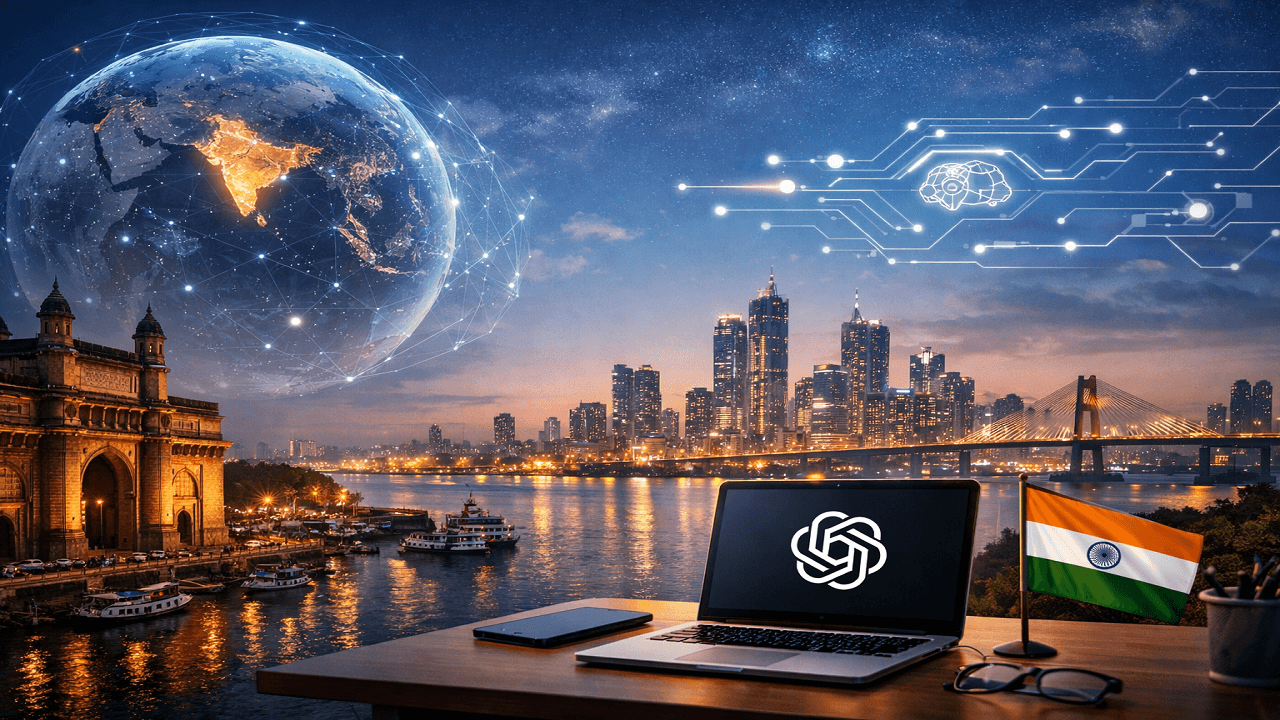
When OpenAI first set its sights on India, the company was venturing into territory that was simultaneously familiar and fiercely competitive. India had already emerged as one of the fastest-growing AI adoption markets in the world, with millions of developers, entrepreneurs, and enterprises hungry for cutting-edge tools. What was once a distant priority on the global expansion map has now become one of the most deliberate, multi-layered strategic plays in OpenAI’s international history. And at the center of that story is a series of bold hiring decisions, landmark partnerships, and a commitment to building something that goes far beyond simply selling subscriptions.
The Appointment That Changed the Game
One of the most telling signals of OpenAI’s seriousness about India came through a key hire that sent ripples through the country’s startup ecosystem. Arjun Gupta, formerly the co-founder and CTO of AuraML — a generative robotics simulation and synthetic data startup that had raised over a million dollars in seed funding and worked alongside industry heavyweights like NVIDIA, AWS, and Google Cloud — was brought on as OpenAI’s first Solutions Architect in India, embedded within the company’s go-to-market team.
The decision to recruit someone with deep roots in India’s startup trenches rather than a traditional enterprise sales background was deliberate. Gupta wasn’t a polished corporate hire — he was someone who had built something from scratch, who understood the pressures of moving from concept to code, from prototype to production. That operational DNA is exactly what OpenAI needed as it tried to build credibility with the tens of thousands of Indian founders who were already integrating AI tools into their products but needed someone who spoke their language — literally and figuratively.
Gupta’s mandate centers on a practical question that many Indian startups wrestle with daily: how do you take a powerful AI model and turn it into something that works reliably at scale, without burning through your runway? His focus areas — architectural design, production deployment, cost management, and bridging technical depth with real business outcomes — reflect a shift in the broader AI ecosystem. The novelty of large language models has worn off. Now the challenge is execution.
Why India? Why Now?
India is not just a large market — it is a structurally unique one. With over 1.4 billion people, a developer base that ranks among the largest in the world, and a startup ecosystem that has produced dozens of unicorns across fintech, edtech, healthtech, and enterprise software, the country represents both a significant revenue opportunity and a critical testbed for AI applications that will eventually scale globally.
As of early 2026, India crossed a remarkable threshold: more than 100 million weekly active ChatGPT users, making it OpenAI’s largest market outside the United States by user volume. That number doesn’t just represent curious early adopters — it includes students using AI for research, teachers building lesson plans, developers shipping AI-native applications, and enterprise teams automating workflows that previously required entire departments.
The scale of adoption has forced OpenAI’s hand in the best possible way. A market this large, and this strategically valuable, demands more than remote management from San Francisco. It demands presence, partnerships, and people who understand the nuances of doing business in India.
Building the Foundation: Offices, Teams, and Structure
OpenAI’s physical expansion in India began taking shape in mid-2025 when the company announced it would open its first corporate office in New Delhi. This was quickly followed by a significant hiring push spanning both the capital and Bengaluru — India’s undisputed technology capital and home to the majority of the country’s high-growth startups and engineering talent.
The team being assembled is intentionally lean for the first year, a strategic choice that reflects hard-won wisdom about how to build in India. A bloated early team often creates more coordination overhead than customer value. Instead, OpenAI has focused on hiring senior, high-leverage roles: account directors, solutions engineers, growth leaders, and partnership leads who can each carry significant independent responsibility.
Pragya Misra, who joined OpenAI as its first India employee to lead public policy and partnerships, has since been elevated to Head of Strategy and Global Affairs for India — a title that reflects the expanding scope of her mandate. She now sits at the intersection of product, policy, enterprise, and government relations, giving OpenAI a single point of strategic ownership in a market where relationships and trust take time to build.
The Tata Partnership: India’s Biggest Enterprise AI Play
No single development illustrated OpenAI’s ambition in India more vividly than the partnership announced with Tata Group at the India AI Impact Summit 2026. Under the agreement, Tata Group committed to deploying ChatGPT Enterprise across its employee base over the coming years, starting with hundreds of thousands of TCS employees — making it one of the largest enterprise AI deployments anywhere in the world.
Beyond software, the collaboration extends into infrastructure. As part of OpenAI’s global Stargate initiative, the two companies are partnering to develop AI-ready data center capacity within India, with OpenAI becoming the first customer of TCS’s HyperVault data center business, beginning with 100 megawatts of capacity and room to scale significantly. This is not a vendor relationship — it is a sovereign infrastructure play, designed to give India data residency, domestic AI capability, and long-term technological independence.
TCS also plans to use OpenAI’s Codex to standardize AI-native software development practices across its engineering teams — a change that would reshape how one of the world’s largest IT services companies writes and ships code. The symbolic weight of that decision is enormous: if TCS is retraining its engineers around OpenAI’s tools, it sets a template for the entire Indian IT industry.
A Startup-First Philosophy
Beyond enterprise behemoths, OpenAI has been equally deliberate about its relationships with India’s startup community. The company has built out dedicated roles specifically for startup engagement, including the Startups Account Director position based in Bengaluru. This role is designed for someone who has lived inside the startup world — a founder, an early employee, or someone who has worked closely with fast-scaling teams — and can navigate the particular rhythms of high-growth, resource-constrained companies.
The rationale is sound. India’s startup ecosystem is not monolithic. It spans early-stage ventures building their first AI-powered product and growth-stage companies integrating language models at scale. Each of these requires a different kind of support: the former needs architectural guidance and API credits; the latter needs enterprise-grade reliability guarantees and co-development roadmaps.
OpenAI has tried to address both ends of this spectrum. Through OpenAI Academy India — launched in partnership with the government’s IndiaAI Mission — the company is offering AI skills training in English and Hindi, with plans to expand into regional languages. The program also provides $100,000 in API credits to selected startups and fellows, lowering the financial barriers to experimentation.
Making AI Affordable: ChatGPT Go
One of the most strategically important product decisions OpenAI made for the Indian market was the launch of ChatGPT Go — a subscription plan priced at just ₹399 per month (roughly $5), designed specifically for price-sensitive users in India. The plan includes higher message limits, image generation capabilities, and file upload features — a meaningful upgrade from the free tier without the friction of premium international pricing.
To accelerate adoption, OpenAI offered the plan for free for 12 months to users who registered during a limited promotional window. The move was smart: it seeded the market, built habitual usage patterns, and positioned ChatGPT as a tool for everyday productivity rather than an aspirational luxury.
Broader Partnerships Across the Ecosystem
The list of Indian companies that have formalized partnerships with OpenAI reads like a who’s who of the country’s digital economy: JioHotstar, PhonePe, CRED, MakeMyTrip, HCLTech, Pine Labs, Cars24, and Eternal. These are not vanity partnerships — they are integrations that embed OpenAI’s models into products used by hundreds of millions of Indians daily.
When a consumer books travel through MakeMyTrip with an AI-powered recommendation engine, or resolves a payment dispute through PhonePe using an intelligent assistant, they are interacting with OpenAI’s technology through Indian interfaces built for Indian contexts. That is the vision — not ChatGPT as a standalone product, but OpenAI as the AI infrastructure layer beneath the digital experiences that define modern Indian life.
What It All Means
OpenAI’s India expansion is not a single announcement or a single hire. It is a coordinated strategy that touches hiring, partnerships, government engagement, product localization, infrastructure, and education. The appointment of startup leaders like Arjun Gupta signals that the company understands India’s builder culture — that respect is earned by being useful, not by being famous.
For India’s AI ecosystem, the implications are significant. Global AI infrastructure is being built, partly, on Indian soil. Indian talent is being employed at the frontier. And Indian startups now have access to technical partners who will sit across the table from them, not just respond to a support ticket.
The question is no longer whether OpenAI is serious about India. The answer to that question has been answered, emphatically, through actions. The more interesting question now is what India will build with the tools it has been given — and how that shapes the global future of artificial intelligence.

Leave a Reply