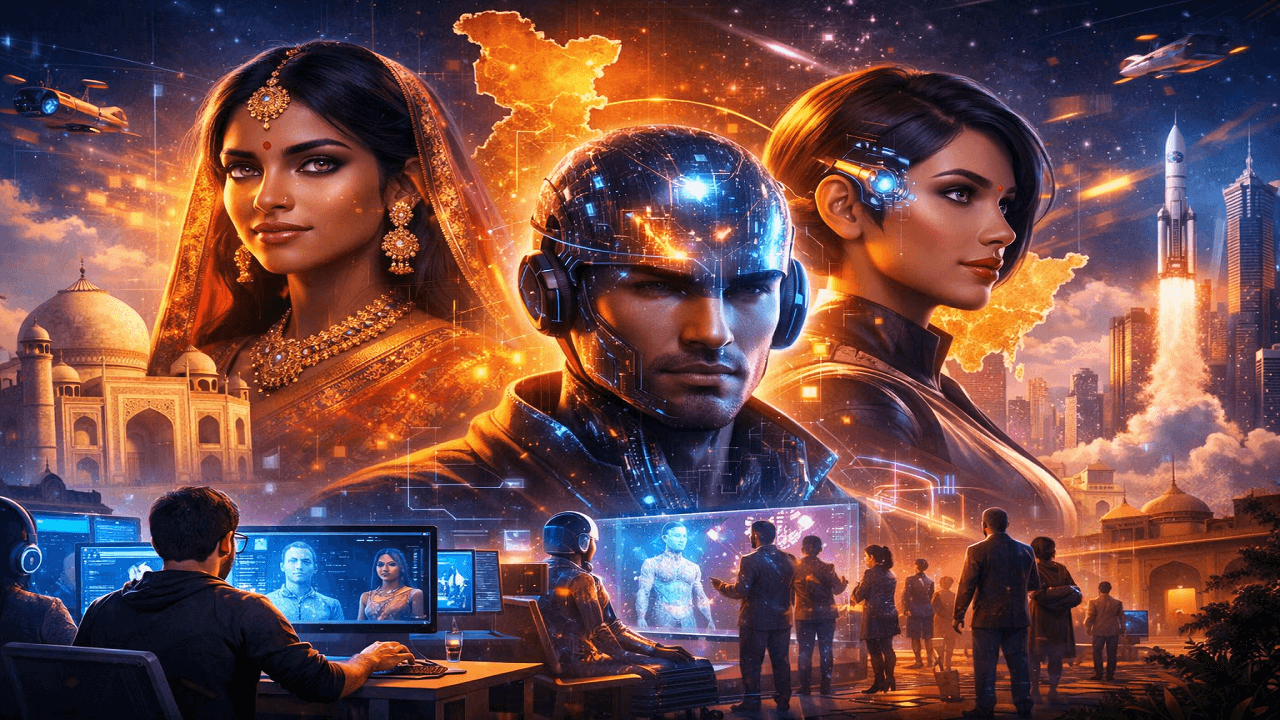
There is a moment happening right now in small towns across Rajasthan, Uttar Pradesh, and Telangana that would have seemed fantastical five years ago. A farmer who has never spoken to a camera in his life sits before a tablet screen. Within minutes, a digital version of him — same skin tone, same accent, same cadence — is explaining crop insurance schemes to other farmers in three different languages simultaneously. He did not record three videos. He did not hire a translator. An AI avatar did it all.
This is India’s AI avatar revolution. And it is not happening quietly.
The Scale Nobody Predicted
When global tech companies began developing AI avatar technology — synthetic digital humans capable of speaking, emoting, and replicating human likeness — the primary markets they imagined were corporate boardrooms in San Francisco and Amsterdam. India was an afterthought. Perhaps a consumer market someday.
That calculation turned out to be spectacularly wrong.
India brings something to the AI avatar equation that no other country can replicate: staggering linguistic complexity layered over a population that has been historically starved of content in its own mother tongue. There are 22 officially recognized languages in India, over 1,600 spoken dialects, and hundreds of millions of people who are functionally excluded from digital content simply because nobody ever made it for them in the language they actually think in.
AI avatars did not just find a market in India. They found a purpose.
The numbers are moving fast. The Indian AI avatar and synthetic media market, which barely existed as a formal category three years ago, is now drawing serious investment from domestic startups, government initiatives, and global players looking to establish early dominance. The applications range from education and government communication to entertainment, healthcare outreach, and the booming creator economy.
Government Finds Its Voice — In 22 of Them
The most consequential early adopters of AI avatar technology in India have not been private companies. They have been government departments.
Communicating policy to a country this size has always been a logistical nightmare. Printing pamphlets works for the literate. Radio reaches rural areas but lacks visual authority. Television advertisements are expensive and geographically scattershot. And hiring human spokespersons for every regional language and every government scheme is both financially impossible and administratively absurd.
AI avatars changed the math entirely.
Several state governments have already piloted programs where a single spokesperson — a real human official — records a message once in Hindi or English. An AI system then generates avatar-driven versions of that message in Tamil, Telugu, Bengali, Odia, Marathi, and several other languages, with accurate lip sync, appropriate regional intonation, and culturally calibrated visual presentation. The avatar does not look robotic or alien. It looks like a trusted, professional communicator who happens to speak your language.
The implications for schemes like Jan Dhan, Ayushman Bharat, and rural financial literacy campaigns are enormous. What previously required months of production across regional media units can now be turned around in hours.
There is a deeper democratic dimension to this. When government communication was only available in Hindi and English, it invisibly excluded hundreds of millions of citizens from fully understanding their own rights and entitlements. AI avatars are, in a quiet and underappreciated way, an instrument of inclusion.
The EdTech Transformation Nobody Saw Coming
India’s edtech sector had a bruising experience after the pandemic boom faded. Valuations crashed, layoffs happened, and the utopian narrative of digital education democratizing learning for every child in every corner of the country looked embarrassingly naive.
AI avatars are giving edtech a genuinely new story to tell — and this time, the story is structurally sounder.
The fundamental problem with recorded video education was always engagement. A teacher recorded in a studio in Bengaluru, speaking formal Hindi or clipped English, feels distant and impersonal to a student in rural Bihar or coastal Andhra Pradesh. The avatar of that same teacher, speaking the student’s dialect, wearing culturally familiar clothing in the background, referencing local context that changes the psychological contract between student and screen.
Several Indian edtech companies are now building what they call “avatar-first” content pipelines. Instead of producing a video and hoping it works across demographics, they produce an avatar performance once and then adapt it language, register, visual context for different learner segments. The economics are compelling. The engagement metrics, early adopters report, are more compelling still.
There is also a fascinating development at the teacher level. Schools in areas suffering severe teacher shortages — and India has hundreds of thousands of such schools — are experimenting with AI avatar teachers who can deliver structured lessons, respond to basic questions using natural language processing, and adapt pacing based on student response patterns. These are not replacements for human teachers. They are presence-fillers in classrooms that otherwise have no presence at all.
Bollywood, YouTube, and the Avatar Creator
India is the world’s largest producer of films. It has one of the world’s largest and most active YouTube creator ecosystems. It has a tradition of celebrity culture that borders on religious devotion. All of this makes India the most volatile and exciting testing ground for AI avatar technology in the entertainment space.
The possibilities are already being explored at the fringes of mainstream entertainment. Deceased actors being digitally recreated for tribute films or uncompleted projects. Living stars licensing their digital likeness for advertisements they would never physically have time to film. Regional cinema dubbing — always a clumsy and lip-sync-challenged process — being replaced by avatar-driven versions where the actor appears to have actually spoken the dubbed language.
The YouTube creator economy is where the avatar revolution is perhaps most democratic. A solo creator who makes content about personal finance, cooking, history, or comedy now has access to tools that allow their avatar to post daily content across multiple language channels simultaneously. The creator records once. Their avatar does the distribution work across linguistic communities that would previously have been inaccessible to them.
This is creating a new class of Indian digital creator — one whose reach is no longer limited by how many languages they personally speak or how many hours they can personally sit in front of a camera.
Healthcare’s Quiet Revolution
Perhaps the most socially significant application of AI avatars in India is happening in healthcare communication — and it is receiving almost none of the media attention it deserves.
India has a chronic and well-documented problem with health misinformation at the community level. Myths about vaccines, maternal health, mental illness, and communicable disease spread through social networks faster than official information ever travels through official channels. Part of the problem is messenger ship. Official health communication, when it exists, tends to arrive in formal language, from visually unfamiliar faces, through channels that rural populations have learned to distrust.
Community health programs are now experimenting with AI avatars that look and sound like local ASHA workers — the frontline female health volunteers who are actually trusted at the village level. These avatars do not replace ASHAs. They extend them, allowing the trusted face and voice of a local health worker to appear on a mobile screen at midnight when a mother is worried about a fever, or on a village WhatsApp group to share vaccination reminders.
The psychological research on this is consistent: people respond better to information that comes from faces and voices they recognize and trust. AI avatars allow that trust infrastructure to scale in ways that human staffing never could.
Mental health is another frontier. India has an acute shortage of mental health professionals and a deeply embedded cultural stigma around seeking psychological help. AI avatar-based mental wellness tools — not therapy, but structured emotional support and psychoeducation — are being built specifically for the Indian context, with avatars that reflect the diversity of Indian faces, speak in regional languages, and are calibrated to cultural norms around discussing family pressure, career anxiety, and relationship stress.
The Technology behind the Transformation
Understanding what is driving this revolution requires a brief look at what the underlying technology actually does — and how it has changed.
Early AI avatars were recognizably artificial. The movements were slightly off. The lip sync lagged. The emotional range was narrow. They were impressive demos, but they failed the basic human test: they felt uncanny rather than trustworthy.
The technology has moved remarkably fast. The latest generation of avatar generation systems, many of which now have strong Indian development teams working on them, can produce photorealistic human performances from a short reference video. They can generate speech in dozens of languages with appropriate emotion, breath, and regional accent. They can maintain visual consistency across long-form content. And they are becoming faster and cheaper with every iteration.
Indian start-ups are not just using imported Western avatar technology. Several home-grown companies are building avatar infrastructure specifically designed for Indian linguistic and visual diversity — systems trained on Indian faces, Indian skin tones, Indian vocal patterns, and the specific phonological features of Indian languages that generic models trained predominantly on Western data have historically struggled with. This is a technical frontier that Indian AI companies are genuinely competitive on at the global level.
The Difficult Questions That Nobody Wants to Answer
No revolution arrives without wreckage, and India’s AI avatar revolution is generating questions that will define its long-term social impact.
The deepest concern is around consent and identity. When a political party creates an AI avatar of a rival politician saying things that politician never said, the democratic damage is real and severe. India has already seen deepfake videos used in political contexts, and the regulatory framework to address this is embryonic at best. The Election Commission, courts, and legislators are all playing catch-up with technology that moves faster than institutional response.
There is also the labor question. India’s voiceover industry, dubbing industry, and the vast ecosystem of regional content creators who made their living precisely because they served linguistic communities that pan-Indian creators ignored — all of these are facing disruption. The technology that democratizes access for audiences simultaneously threatens livelihoods for human creators who served those audiences.
The cultural authenticity question is subtler but equally important. An AI avatar speaking Bhojpuri may hit the phonemes correctly while missing the cultural soul of the language — the idioms, the humor, the embedded social knowledge that native speakers carry unconsciously. Languages are not just communication systems. They are cultural repositories. Whether AI avatars can eventually carry that depth, or whether they will produce a flattened, algorithmically competent but culturally hollow version of India’s linguistic richness, remains genuinely open.
What Comes Next
India is not passively receiving the AI avatar revolution. It is co-creating it — with the specific pressures of its scale, its diversity, and its unfinished democratic project of making the country’s full bounty accessible to every one of its citizens.
The next five years will likely see AI avatars move from novelty to infrastructure. They will be embedded in government service delivery, healthcare communication networks, school systems, and the creator economy as standard tools rather than exotic experiments. The Indian companies building this technology will compete seriously at the global level, not just as vendors but as innovators shaping how the world thinks about synthetic human presence.
The farmer in Rajasthan explaining crop insurance in three languages simultaneously is not the end of this story. He is barely the beginning. What India does with AI avatars the ethical frameworks it builds, the creative uses it invents, the missteps it has to course-correct will shape how the world’s largest democracy navigates the most profound shift in human communication since the printing press.
A billion faces are going digital. The revolution has already begun.

Leave a Reply