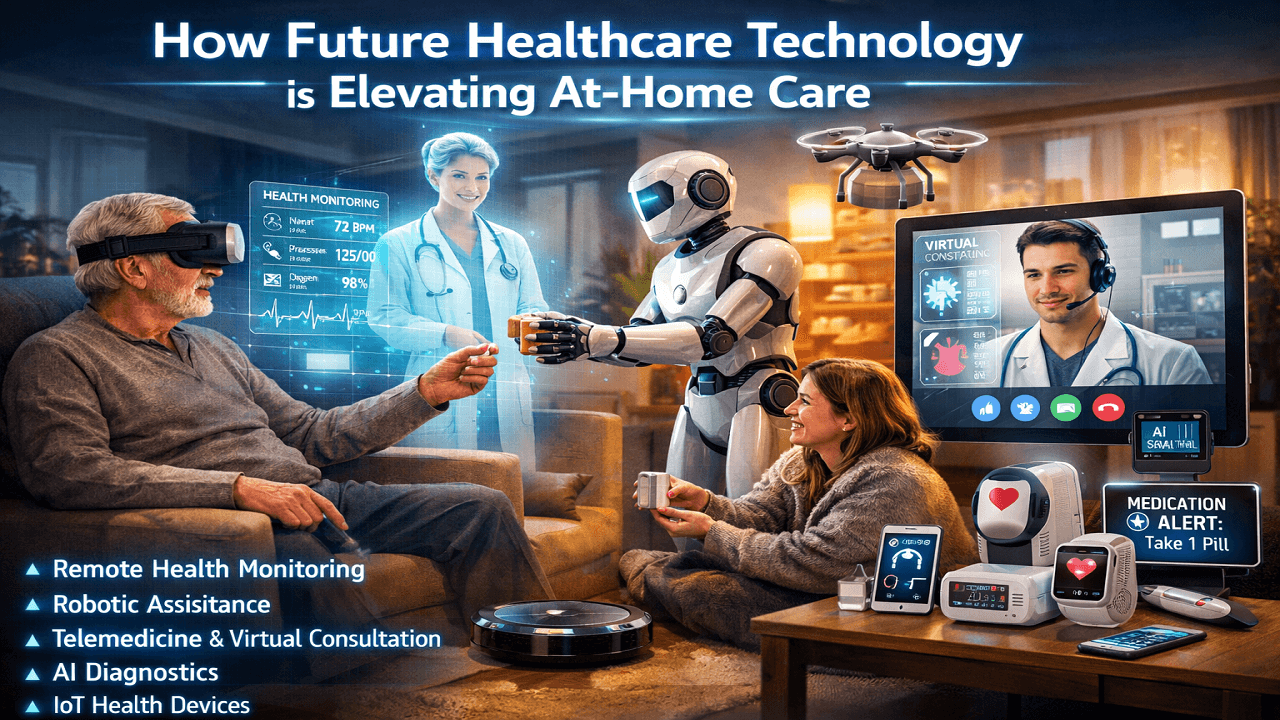
HEALTHCARE TECHNOLOGY | FUTURE OF MEDICINE
The home is fast becoming the most advanced healthcare setting in history — and technology is the reason why.
Imagine waking up, slipping on a smartwatch, and knowing that by the time you pour your morning coffee, a clinical-grade sensor has already checked your heart rhythm, flagged your blood oxygen, and quietly sent a health summary to your doctor — all before you have uttered a single word. This is not science fiction. This is 2025, and this is just the beginning.
For most of recorded medical history, healthcare happened somewhere else — a clinic, a hospital, a specialist’s office. The patient was summoned. Now, for the first time, the relationship is reversing. Technology is bringing medicine to the patient, meeting them in the place where they already are: home. And it is doing so at a level of sophistication that would have seemed impossible just a decade ago.
The global home healthcare market crossed $390 billion in 2024 and is expected to more than double within a decade. Behind that number is a profound shift in how we think about medicine, patient empowerment, and what it means to receive care. Here is a deep look at the technologies driving that transformation.
1. Wearables That Go Far Beyond Fitness Tracking
The first generation of wearables gave us step counters and rough heart rate estimates. Useful, perhaps, for motivating a longer walk — but hardly clinical. The second generation is something fundamentally different.
Devices emerging today can continuously measure blood oxygen saturation, electrocardiograms, blood glucose levels, body temperature, hydration, and even biomarkers found in sweat — all from a slim band worn on the wrist or a patch the size of a bandage. Smartwatches now detect atrial fibrillation, an irregular heart rhythm that dramatically increases stroke risk, with clinical-grade accuracy. The moment an abnormality is detected, the device alerts both the wearer and their physician.
Non-invasive continuous glucose monitors are eliminating the need for finger-prick blood draws that diabetic patients have endured for decades. Long-term cardiac patches monitor heart activity for weeks at a time, transmitting data wirelessly. For patients with chronic conditions, this means real-time visibility into their health that no weekly doctor visit could ever replicate.
The real power, however, lies not in the sensors alone but in what happens to the data they generate. Raw biometric readings are meaningless without interpretation. That is where artificial intelligence enters the picture.
2. Artificial Intelligence: The Always-On Clinician
Artificial intelligence is the connective tissue of the home healthcare revolution. It transforms continuous streams of biometric data into clinical insights, personalises care pathways based on individual responses, and identifies patterns invisible to even the most experienced human clinician.
Machine learning models trained on millions of patient records can now distinguish a benign arrhythmia from a potentially fatal one. They can detect the early warning signs of sepsis hours before symptoms become obvious. They can identify the subtle physiological shifts that precede a diabetic crisis and trigger an alert in time to prevent it. All of this happens automatically, continuously, without requiring a clinician to manually review data.
AI-powered symptom checkers have matured far beyond simple triage chatbots. The latest systems accept multimodal inputs — photographs of skin conditions, audio recordings of coughs, gait analysis captured by a smartphone camera — and integrate them with medical history to assist with differential diagnosis. These tools are not replacing physicians. They are extending their reach, giving clinicians richer, more continuous clinical context than any brief office visit could provide.
In oncology, AI-controlled wearable infusion devices allow cancer patients receiving chemotherapy to do so at home, with algorithms tracking side effects in real time and adjusting drug delivery protocols accordingly. What once required hospitalisation now takes place between a patient’s own four walls, with family nearby and their dignity intact.
3. Telehealth: From Pandemic Stopgap to Clinical Standard
The pandemic compressed a decade of telehealth adoption into a matter of months. What began as an emergency measure has matured into a robust pillar of modern care delivery. But the telehealth of today looks almost nothing like a pandemic-era video call.
Advanced telehealth platforms now integrate directly with home diagnostic hardware. Before a virtual appointment, a patient might use a connected stethoscope to transmit heart and lung sounds, a digital otoscope to share ear canal images, a synced blood pressure cuff, and an AI-powered skin camera to document a lesion — all before the physician joins the call. The clinician receives a comprehensive data package and can conduct what amounts to a thorough physical examination without either party leaving their location.
This is also an equity story. Specialist access has historically been a privilege of geography and income. A patient in a rural area, hours from the nearest major medical centre, can now consult a cardiologist, endocrinologist, or neurologist via telehealth, share device-generated clinical data, and receive expert guidance without travel. The democratisation of specialist care may be one of home healthcare technology’s most profound long-term contributions.
4. Remote Patient Monitoring: Closing the Gap Between Visits
Remote Patient Monitoring, or RPM, pairs home-based devices with clinical oversight teams who review continuous data feeds between appointments. The results are compelling. RPM programs consistently reduce hospital readmissions for heart failure patients by 38 to 40 percent. Emergency department visits drop significantly. Medication adherence improves. Complications are caught earlier, when intervention is simpler and less costly.
Medicare and most major insurers now reimburse RPM services, removing a critical barrier to adoption. Health systems and technology startups alike are racing to build end-to-end RPM ecosystems that integrate devices, software platforms, and care coordination teams seamlessly. For chronically ill patients, RPM is transforming the experience of having a long-term condition — from one of sporadic, reactive clinic visits to one of continuous, proactive support.
5. Smart Medication Management: Solving One of Medicine’s Oldest Problems
Medication non-adherence is one of the most persistent and expensive problems in all of healthcare. It contributes to an estimated 125,000 preventable deaths annually in the United States and tens of billions in avoidable costs. Technology is attacking this problem from multiple directions simultaneously.
Smart pill dispensers have become standard equipment for elderly and chronically ill patients. These connected, automated devices sort medications by dose and time, deliver them on schedule with visual and audible alerts, and immediately notify caregivers or clinical teams if a dose is missed. Advanced models incorporate biometric confirmation to ensure the correct patient takes their medication — critical for complex regimens such as antiretroviral therapy or transplant immunosuppression, where precision is not optional.
Digital pills represent the frontier. Capsules embedded with ingestible microsensors transmit a signal to a wearable patch once they dissolve in stomach acid, creating an objective real-time record of medication ingestion. Already FDA-approved for certain psychiatric medications, this technology eliminates all ambiguity about whether a patient has taken their dose — a genuine breakthrough in conditions where adherence is both critical and historically difficult to verify.
6. Robotics and the Intelligent Home Health Ecosystem
Robotics in home healthcare spans a wide spectrum. At one end are sophisticated social robots — compact, expressive machines designed to engage users in conversation, deliver medication reminders, and monitor for signs of cognitive decline. At the other end are physically capable care robots that assist with mobility, help patients transition from bed to wheelchair, and conduct fall-risk assessments using onboard cameras and motion sensors.
Smart home systems, increasingly integrated with health platforms, add a powerful layer of ambient care. Motion sensors map an occupant’s daily activity patterns and flag significant deviations — a person who always makes breakfast by seven in the morning failing to appear in the kitchen by ten triggers an automatic wellness check. Voice-activated assistants coordinate medication schedules, connect patients with care teams, and provide the cognitive stimulation known to slow dementia progression.
The convergence of these systems creates what researchers are calling an intelligent home health ecosystem — an environment that monitors its occupants passively, learns their baselines, and responds to deviations without requiring the patient to do anything at all. This passive monitoring model is especially powerful for populations who may not recognise or report early symptoms themselves, including those with dementia or severe chronic illness.
7. Mental Health and the Rise of Digital Therapeutics
At-home healthcare technology is not limited to the physical body. Mental health care — long hampered by chronic access shortfalls, stigma, and treatment gaps — is being reshaped by digital therapeutics and AI-powered behavioural health platforms.
Digital therapeutics, or DTx, are clinically validated software-based interventions that deliver measurable therapeutic benefit through a device. FDA-cleared apps now exist for insomnia, substance use disorder, ADHD, and anxiety, delivering structured cognitive behavioural therapy protocols and personalised behavioural interventions with no in-person component required. For the millions of people who cannot access a therapist due to cost, geography, or waitlists, these tools represent a genuine lifeline.
AI-powered mental health companions engage users in natural conversation, apply evidence-based frameworks, monitor for linguistic patterns associated with deteriorating mental health, and escalate to human clinicians when risk factors emerge. These tools work best not as replacements for therapy but as extensions of it — maintaining the therapeutic relationship between sessions and providing round-the-clock support for those who need it most.
8. The Challenges That Must Be Solved
The home healthcare revolution carries real complexity alongside its promise, and intellectual honesty demands we name it clearly.
Data privacy is the most pressing concern. Continuous biometric monitoring generates vast quantities of deeply sensitive personal health information. Developers and policymakers share responsibility for establishing rigorous security standards, consent frameworks, and clear rules about how that data can be used — and by whom. Regulatory frameworks are evolving but lag behind the pace of technological development in most parts of the world.
Digital equity is an equally serious barrier. The populations who stand to benefit most from at-home healthcare technology — low-income communities, rural populations, elderly individuals — are often those with the least access to reliable broadband connectivity, digital literacy, or the devices themselves. Without deliberate policy intervention and targeted investment, the home healthcare revolution risks becoming a privilege of the already-privileged.
And there is something more fundamental: the human dimension of care. Medicine is not only a technical enterprise. The relationship between patient and clinician carries its own therapeutic weight. The best implementations of home healthcare technology will augment that relationship — extending its reach, deepening its continuity — rather than substituting a sensor for a human being.
The Future Is Already Home
Within a decade, continuous biometric monitoring, AI-driven clinical support, and sophisticated remote care platforms will be as routine as the family medicine cabinet. Hospital-at-home programs — already deployed by dozens of leading health systems — will expand, delivering acute-level care to patients recovering from surgery, managing exacerbations of chronic illness, or undergoing treatments that once required inpatient stays.
The goal is not to hollow out the healthcare system. It is to redistribute where care happens — moving routine monitoring, medication management, behavioural health support, and early intervention out of expensive, inconvenient clinical settings and into the environments where people actually live. What remains in the hospital will be higher-acuity, more complex, and more precisely matched to what that setting does best.
For patients, this means greater control, deeper dignity, and care shaped around their lives rather than institutional schedules. For health systems, it means more efficient use of scarce clinical resources and a meaningful answer to the pressure of ageing populations, rising chronic disease burdens, and healthcare workforce shortages.
The future of healthcare is not in some gleaming hospital of tomorrow. It is in the home you live in now, quietly being transformed by technologies being built today. The house is becoming a clinic. The living room, a monitoring suite. And the patient — finally, irreversibly — at the centre of it all.
FAQs
1. What types of conditions can be managed at home using healthcare technology?
A wide range of chronic and acute conditions can now be managed at home, including heart disease, diabetes, COPD, hypertension, cancer (during chemotherapy), post-surgical recovery, mental health disorders, and dementia. Remote monitoring devices and AI platforms make it possible to track these conditions continuously and flag complications early, reducing the need for frequent hospital visits.
2. Is at-home healthcare technology safe and clinically reliable?
Yes — many devices used in home healthcare are FDA-cleared or CE-marked and held to the same clinical standards as hospital equipment. Continuous glucose monitors, cardiac patches, and AI-powered diagnostic tools have been validated in large clinical studies. Additionally, most remote patient monitoring programs are overseen by licensed clinicians who review data and intervene when needed, ensuring professional medical oversight remains in place.
3. How does remote patient monitoring actually work?
Remote Patient Monitoring (RPM) involves a patient using connected devices at home — such as blood pressure cuffs, pulse oximeters, wearables, or smart scales — that automatically transmit health data to a clinical care team. Software platforms analyze the incoming data in real time, alert nurses or physicians when readings fall outside safe ranges, and allow for timely intervention. Patients are typically enrolled in an RPM program by their doctor and receive devices along with instructions for use.
4. Will health insurance cover at-home healthcare technology?
Coverage is expanding rapidly. In the United States, Medicare now reimburses Remote Patient Monitoring services, and most major private insurers have followed suit. Telehealth consultations are broadly covered, and coverage for digital therapeutics is growing as more products receive FDA clearance. However, coverage varies by plan, provider, and geography, so patients are advised to check with their insurer for specifics on what is included.
5. What are the biggest risks or downsides of at-home healthcare technology?
The main concerns are data privacy, digital equity, and over-reliance on technology. Continuous health monitoring generates highly sensitive personal data that must be protected against breaches and misuse. Many at-home tools also require reliable internet access and digital literacy, which not all patients have — creating a risk that these advances benefit the already-advantaged. Finally, technology should complement, not replace, the human relationship between patient and clinician, which remains central to quality care.

Leave a Reply