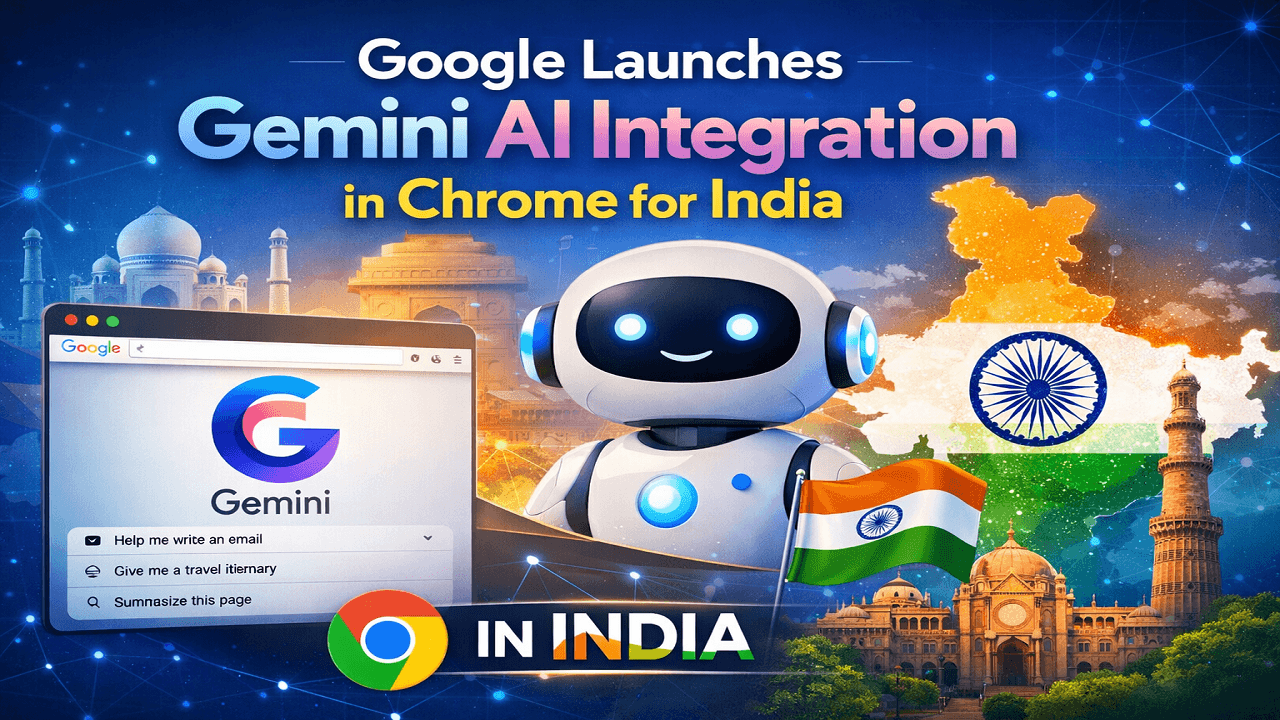
Google has made significant progress in integrating AI into regular browsing. India, Canada, and New Zealand are among the new regions where Gemini integration for Chrome will be available, according to the business. For Indian internet users, having access to one of the most powerful AI helpers integrated into their browser is a significant milestone.
The upgrade allows users to engage with the AI helper while browsing by directly integrating the Gemini model into Chrome. This implies that opening a different app or going to a different website is not necessary. Within the browser, the assistant is present and available to assist at any time.
The rollout lets users access Gemini in Chrome through a sidebar on desktop. The sidebar sits beside the current tab without replacing or interrupting it. Users can ask questions, get summaries, and complete tasks while still looking at the webpage in front of them.
Users can complete activities like making a pop quiz for an impending test and summarize vast web information with the aid of the integrated AI. It can also recall previously viewed pages and provide answers to queries like how to cook a vegan recipe. This final element is quite helpful. Because they are fearful of forgetting anything crucial, people frequently have dozens of open tabs. That issue is now resolved by Gemini.
The browsing assistant can carry out particular actions in the side panel in addition to providing basic summaries. Users can seek directions on how to modify an online recipe or ask it to create a practice test based on an article they are reading. Professionals, researchers, and students will all benefit from this type of functionality.
One of the most exciting aspects of this launch is how it connects the browser to the wider Google ecosystem. Chrome’s AI features connect with several Google services such as Gmail, Maps, Calendar, and YouTube. This allows users to perform tasks without leaving the page they are currently browsing. For example, a user reading about an event can immediately check their calendar or draft a related email, all from the same window.
Gemini can compose an email using the data on the current screen if prompted. After editing the draft on the side panel, the user only needs to click to send it. As a result, the browser becomes an active workspace rather than a passive reading tool.
A significant improvement is also being made to image editing. Using text prompts in the side panel, users can instantly alter images with an integrated picture tool. Users can instruct the AI on how to alter a picture rather than downloading it, launching an editor, and then submitting it again. For designers, marketers, and content producers who spend a lot of time in browsers, this is a useful tool.
For Indian users specifically, language support is a massive addition. Gemini will support languages including Hindi, Bengali, Gujarati, Kannada, Malayalam, Marathi, Telugu, and Tamil, in addition to English. India has over a billion people who speak many different languages. Bringing AI assistance in regional languages is a significant move toward making the technology truly inclusive.
These AI features will initially be available on desktop and iOS devices. Gemini in Chrome can be launched from the top-right corner of the browser, keyboard shortcuts, Mac menu bar, or Windows system tray. It is available as a floating window or a side panel docked to the current tab. Getting started requires nothing more than a tap or a click.
But not all of the features found in the US will be available in India just yet. For US-based users, Google expanded its agentic capabilities, which allow it to take control of a browser and do things on the user’s behalf. This feature is not included in the company’s most recent expansion for users in Canada, New Zealand, and India. This implies that while Indian users will receive the essential functions, they would have to wait a little longer for the ability to handle tasks more independently.
Security has also been given careful thought. Google has trained its models to recognize known threats, like prompt injection, in order to keep users safe while browsing. The system includes safeguards to ask for confirmation before taking certain sensitive actions, like sending an email or adding an event to a calendar. Users remain in control of what the AI does and does not do on their behalf.
Reducing the need to open several tabs or apps while performing routine internet operations is the goal. Google has been working toward this goal of a more cohesive, intelligent browser for some time. One of the biggest moves in that direction is the launch in India.
Google claims that throughout the remainder of 2026, Gemini in Chrome will be accessible in more nations and languages. As of right moment, one of the first significant overseas areas to receive this rollout is India. The vast and quickly expanding digital population of the nation is shown in this.
Last year, a wave of AI browsers from companies like OpenAI, Perplexity, Opera, and The Browser Company launched with the aim to replace Chrome. Google is now answering that challenge head-on. By embedding Gemini directly into the world’s most used browser, it is making a strong case that users do not need to switch platforms to experience the future of AI-powered browsing.
For India, this launch is not just a technology update. It is an invitation to hundreds of millions of users to experience the internet in a smarter, faster, and more connected way than ever before.

Leave a Reply