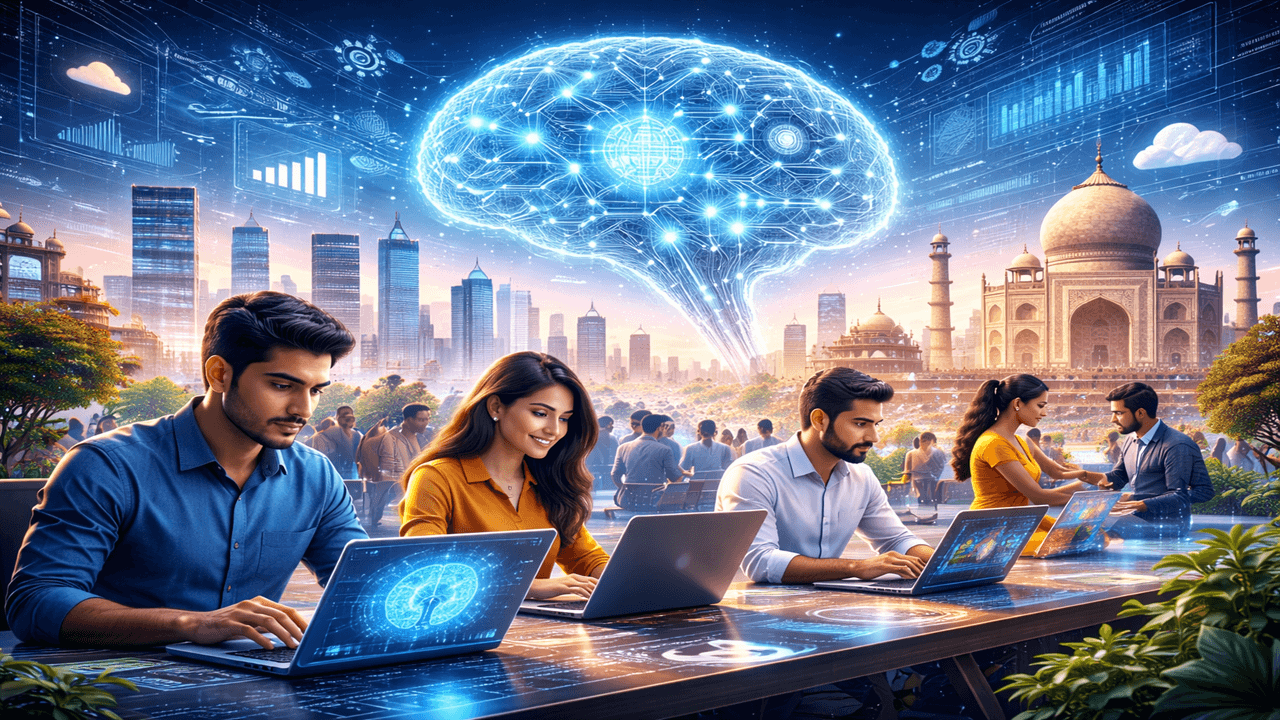
India is at the epicenter of a revolution in technology. India’s IT landscape is changing as a result of the emergence of generative AI. What started off as small-scale research in a few tech laboratories has now grown into a massive movement. Businesses are making significant investments, hiring quickly, and creating goods that are attracting attention from all around the world.
The AI boom in India did not happen overnight. It has been building steadily over the past few years. But 2024 and 2025 accelerated everything. Global demand for AI-powered services surged. Indian IT firms were ready to meet that demand. They had the talent, the infrastructure, and the ambition. The timing could not have been better.
India already had one of the world’s most robust IT sectors. However, it now has a new engine thanks to generative AI. These days, companies like Infosys, TCS, Wipro, and HCL are more than just service providers. They are developing AI solutions. They have all started specialized generative AI practices. Thousands of engineers are being trained by them. They are entering into new agreements based only on AI capabilities.
The India AI industry growth numbers tell a compelling story. According to industry reports, India’s AI market is expected to touch $17 billion by 2027. Investment from both domestic and foreign sources is pouring in at record levels. Venture capital firms are actively scouting for the next big AI breakthrough coming out of Bengaluru, Hyderabad, Pune, and Chennai.
Bengaluru continues to be the movement’s central hub. There are currently around 400 AI-focused businesses in the city. Every week, new offices open. Teams developing AI tools for healthcare, finance, education, and logistics are crowding coworking spaces. The city is powered by electricity. It appears that everyone is working on an AI-related project.
The rise of Generative AI startups India is one of the most exciting parts of this story. Young founders are building companies that would have seemed impossible just five years ago. Startups like Sarvam AI, Krutrim, and CoRover are creating tools specifically designed for Indian users. They are building in local languages. They understand the unique challenges of the Indian market. That local knowledge is a major competitive edge.
These startups are doing more than simply imitating Western businesses. They are innovating in ways that are relevant to the requirements of India. Tamil-speaking chatbot. a legal assistant with Indian legal training. A medical gadget that is aware of local medical customs. These are not trivial concepts. For hundreds of millions of people, these items provide solutions to actual issues.
The AI revolution in Indian IT sector is also changing how existing businesses operate. Banks are using generative AI to detect fraud faster. Hospitals are using it to read medical reports more accurately. Retailers are using it to personalize shopping experiences. The applications are growing every day. What was once considered cutting-edge is quickly becoming standard practice.
Talent is a huge part of this story. India produces more than 1.5 million engineering graduates every year. Many of them are now pivoting toward AI. Universities are updating their curriculums rapidly. IITs and IIMs are launching new AI programs. Private bootcamps are running full capacity. The country is manufacturing AI expertise at scale.
Global tech giants have taken notice. Google, Microsoft, Amazon, and Meta have all expanded their AI research and development presence in India. They are not just outsourcing work. They are building core AI teams on Indian soil. This is a signal of how much trust the global tech world now places in Indian talent.
The government is also playing an active role. The IndiaAI Mission, backed by significant public funding, aims to build AI infrastructure across the country. Plans include dedicated computing clusters, data centers, and AI research hubs. The goal is to make India not just an AI consumer but a genuine AI producer. Policymakers understand the stakes. They want India to have a seat at the global AI table.
Despite all the excitement, challenges remain. Access to high-quality data is still a problem. Many Indian languages are underrepresented in global AI training datasets. Computing costs can be high for smaller startups. Regulatory clarity around AI use is still evolving. Ethical concerns about bias and privacy need serious attention.
Additionally, there is the issue of employment. Some fear that labor may be replaced by AI, especially in entry-level IT positions. There is merit to that worry. The industry as a whole is already seeing changes in job definitions due to automation. Nonetheless, a few of experts contend that AI is generating more employment than it is removing. Every month, new positions in prompt engineering, model evaluation, AI ethics, and AI training are created.
The Generative AI in India story is ultimately one of reinvention. India’s IT sector reinvented itself once before, in the 1990s, when it embraced software outsourcing and became the world’s back office. It is doing something similar now. But this time, India is not just executing someone else’s vision. It is building its own.
The AI boom in India is creating opportunities that extend beyond big cities. Tier-2 cities like Coimbatore, Jaipur, Indore, and Nagpur are emerging as new AI hubs. Remote work made this possible. Talented engineers who once had to migrate to metros can now build AI products from their hometowns. This is broadening the geographic base of the industry in important ways.
The India AI industry growth trajectory looks strong for the years ahead. The foundation is solid. The talent pipeline is deep. The startup ecosystem is maturing. Government support is increasing. Global demand for AI services is not slowing down.
India has always been a country that finds a way to punch above its weight in technology. The AI revolution in Indian IT sector is the latest proof of that spirit. The country is not just participating in the global AI movement. It is helping to shape it. And the world is starting to pay close attention.

Leave a Reply