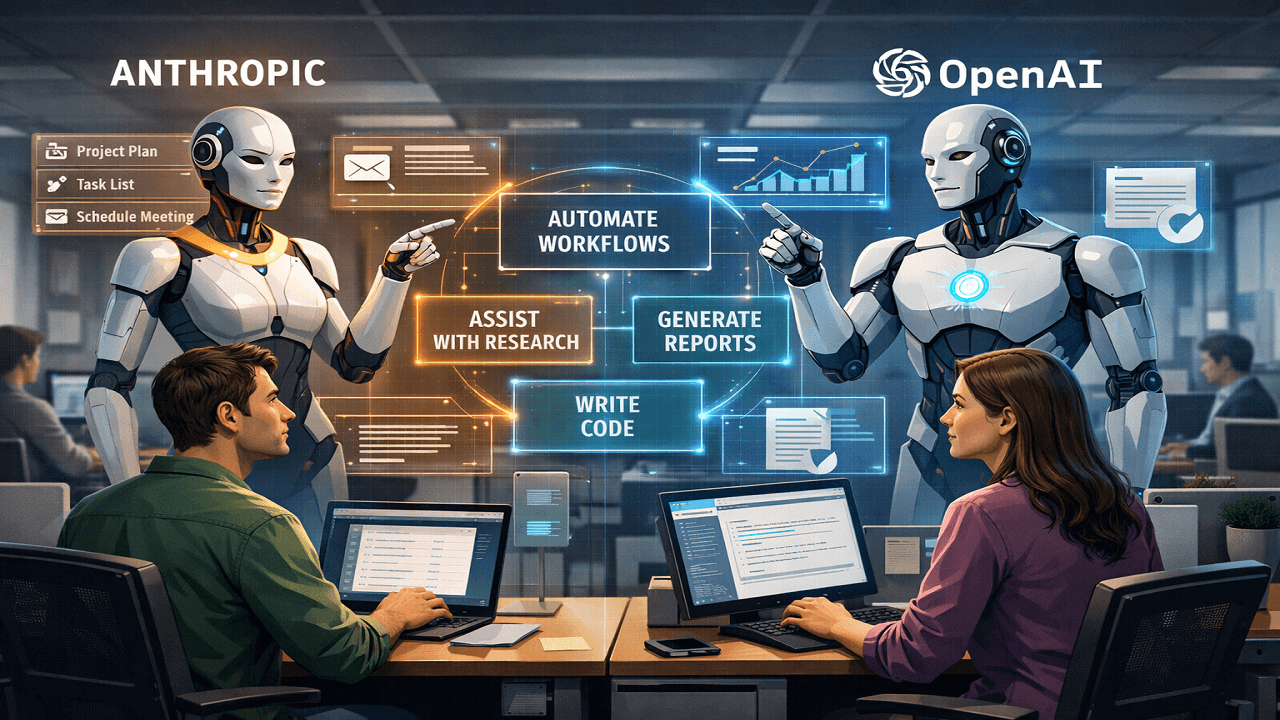
The artificial intelligence industry is entering a new phase as leading companies shift their focus from conversational chatbots to autonomous “agentic” AI systems capable of completing complex tasks with minimal human oversight. Anthropic and OpenAI, two of the sector’s most prominent players, are racing to deploy AI agents that can navigate software applications, manage workflows, and execute multi-step processes in workplace environments.
This evolution represents a fundamental reimagining of how AI integrates into professional settings. Rather than serving merely as assistive tools that respond to prompts, agentic AI systems are designed to take initiative, make decisions, and operate with a degree of independence that more closely resembles human employees than traditional software.
The Rise of AI Agents
The term “agentic AI” refers to systems that can pursue goals autonomously, breaking down complex objectives into smaller tasks, using tools and applications, and adapting their approach based on results. Unlike conventional AI assistants that wait for instructions, these agents can proactively identify problems, devise solutions, and execute plans across multiple platforms and applications.
OpenAI has introduced several agentic capabilities through its platform, including enhanced function-calling abilities that allow its models to interact with external tools and APIs more effectively. The company’s GPT-4 series and newer iterations have demonstrated improved reasoning abilities that enable them to handle intricate workflows requiring multiple steps and decision points.
Anthropic has similarly embraced this direction with Claude, particularly through products like Claude Code, which allows developers to delegate entire coding tasks directly from the terminal. The company has also launched browser-based agents and spreadsheet integrations designed to automate knowledge work that previously required constant human attention. These tools can navigate user interfaces, manipulate data, and complete tasks that span multiple applications.
Workplace Applications and Use Cases
The practical applications of agentic AI in workplace settings are expanding rapidly. In software development, AI agents can write code, debug programs, run tests, and even deploy applications with limited human intervention. Marketing teams are experimenting with agents that can research competitors, draft campaign materials, and schedule social media content. Customer service operations are deploying agents capable of handling complex inquiries that require accessing multiple databases and systems.
Financial analysis provides another compelling use case. AI agents can gather data from various sources, build financial models, generate reports, and flag anomalies or opportunities for human review. Legal departments are exploring agents that can review contracts, conduct research across case law databases, and draft preliminary documents.
The efficiency gains can be substantial. Tasks that might consume hours of human time—such as compiling information from disparate sources, formatting reports, or coordinating across multiple software platforms—can often be completed by AI agents in minutes. This compression of timelines promises to accelerate decision-making and free human workers for higher-level strategic thinking.
Technical Foundations and Limitations
The technical capabilities enabling agentic AI have emerged from advances in several areas. Large language models have developed stronger reasoning abilities, allowing them to plan multi-step processes more reliably. Improvements in computer vision enable agents to interpret user interfaces and navigate applications designed for human users. Enhanced memory systems help agents maintain context across extended tasks and remember information from earlier in their workflows.
However, significant limitations remain. AI agents can struggle with ambiguous instructions, make logical errors when planning complex sequences, and occasionally misinterpret user interface elements. They may confidently pursue incorrect approaches when operating autonomously, potentially wasting time or creating errors that require human correction. Reliability remains inconsistent, with success rates varying considerably depending on task complexity.
Security and privacy concerns also loom large. Granting AI systems access to company databases, email accounts, and business applications creates new attack surfaces and raises questions about data handling and confidentiality. Organizations must carefully consider which permissions to extend to AI agents and implement appropriate guardrails.
Economic and Workforce Implications
The deployment of agentic AI raises important questions about workforce dynamics. While proponents argue that agents will handle tedious tasks and amplify human productivity, concerns about job displacement are inevitable. Roles focused on routine information processing, basic analysis, and administrative coordination may face particular pressure.
The technology industry itself may experience early impacts, as AI agents become increasingly capable of handling coding, testing, and deployment tasks. Knowledge workers in fields like finance, law, marketing, and consulting could see their roles evolve substantially as agents take over discrete components of their workflows.
However, history suggests that technological automation often creates new categories of work while eliminating others. Demand for AI supervisors, prompt engineers, system integrators, and specialists who can effectively collaborate with AI agents may expand. The ability to effectively direct and work alongside AI agents could become a core professional competency across industries.
The Competitive Landscape
The push toward agentic AI reflects intense competition among leading AI companies to demonstrate practical value and justify their substantial research investments. Both Anthropic and OpenAI are racing to prove that their systems can deliver tangible business results beyond impressive demonstrations.
This competition is driving rapid iteration and deployment, sometimes ahead of complete solutions to reliability and safety challenges. Companies are balancing the desire to capture market share against the need to avoid high-profile failures that could damage trust in AI systems generally.
Other players including Google, Microsoft, and a constellation of startups are developing their own agentic capabilities, creating a dynamic ecosystem of competing approaches and technologies. Enterprise software companies are simultaneously working to integrate AI agents into their existing platforms, potentially becoming distribution channels for the underlying models.
Looking Ahead
As agentic AI systems become more capable and widely deployed, society will need to grapple with important governance questions. How should accountability work when AI agents make consequential decisions? What transparency requirements should exist around AI agent actions? How can organizations ensure agents operate within ethical boundaries and legal requirements?
The answers will shape how this technology integrates into workplaces and daily life. The transformation has already begun, with Anthropic, OpenAI, and their competitors working to define what autonomous AI looks like in practice. The coming years will reveal whether agentic AI delivers on its promise of revolutionizing knowledge work or whether the challenges of reliability, safety, and human-AI collaboration prove more stubborn than anticipated.

Leave a Reply