Artificial Intelligence (AI) has become a cornerstone of modern digital transformation. From predictive analytics and intelligent automation to conversational interfaces and personalized user experiences, AI solutions are revolutionizing industries. As businesses increasingly invest in AI-driven technologies, the demand for skilled AI developers continues to rise.
Hiring the right AI talent is crucial, but equally important is choosing the most suitable engagement model. The engagement model determines how you collaborate with your development partner, manage costs, control workflows, and ensure timely delivery. In this guide, we explore various engagement models and help you choose the best one for your AI project.
Why Hiring an AI Developer Matters
AI projects are complex and require specialized expertise in machine learning, deep learning, data engineering, natural language processing, and cloud infrastructure. An experienced AI developer ensures:
-
Accurate model development and training
-
Scalable and secure architecture
-
High-performance algorithms
-
Compliance with data protection standards
-
Continuous optimization and maintenance
Whether you’re building an intelligent recommendation engine, predictive analytics platform, or conversational AI system, hiring the right expertise directly impacts project success.
Understanding Engagement Models in AI Development
An engagement model defines how your project is structured, billed, managed, and executed. Selecting the right model ensures cost efficiency, flexibility, and smooth collaboration.
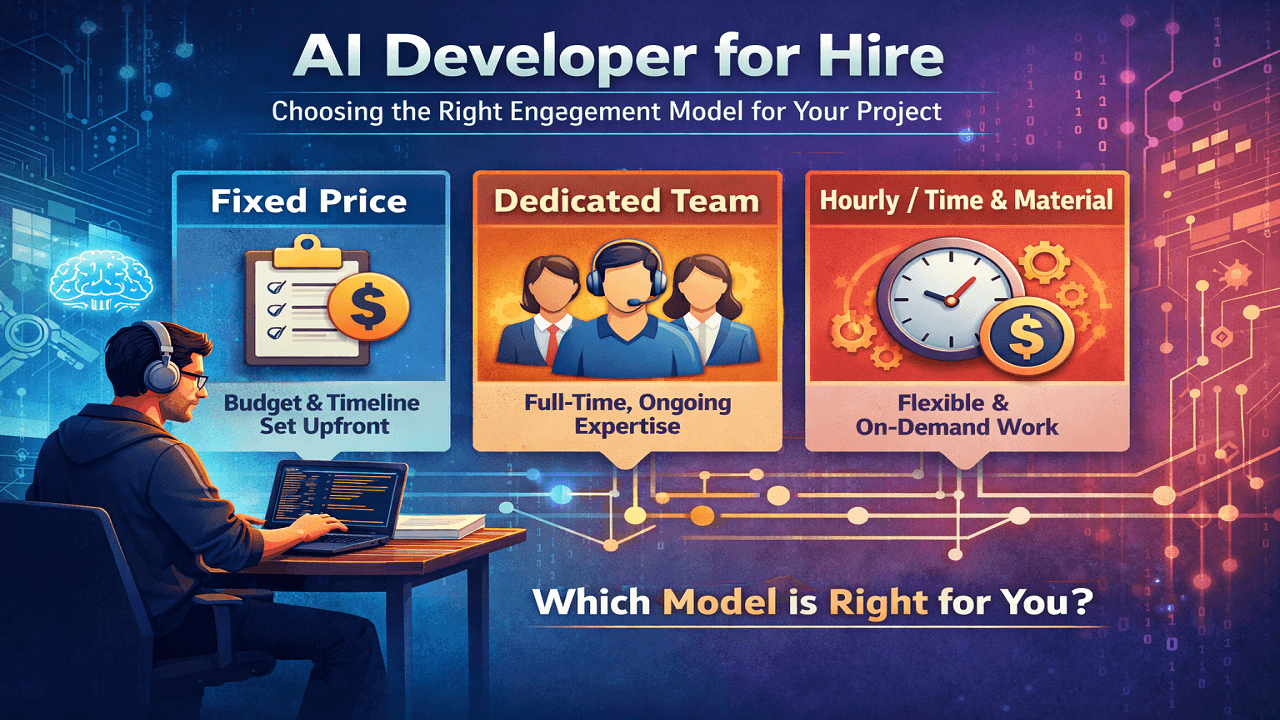
The three most common engagement models are:
-
Fixed Price Model
-
Time and Material (T&M) Model
-
Dedicated Team Model
Let’s explore each in detail.
1. Fixed Price Model
What It Is:
In the fixed price model, the project scope, timeline, and cost are clearly defined before development begins. Both parties agree on deliverables and pricing upfront.
Best For:
-
Small to medium-sized projects
-
Well-defined requirements
-
Short-term development cycles
Advantages:
-
Predictable costs
-
Clear timelines
-
Low financial risk
Limitations:
-
Limited flexibility for changes
-
Scope modifications may increase costs
-
Not ideal for evolving requirements
This model works well when project objectives and technical requirements are stable from the beginning.
2. Time and Material (T&M) Model
What It Is:
In the T&M model, you pay for the actual time and resources utilized in the development process. This approach offers flexibility and adaptability.
Best For:
-
Dynamic projects
-
Changing requirements
-
Long-term innovation initiatives
Advantages:
-
High flexibility
-
Continuous improvement
-
Transparent billing
Limitations:
-
Budget predictability is lower
-
Requires active project management
This model is ideal for AI projects involving research, experimentation, and iterative development, where outcomes evolve based on insights and testing.
3. Dedicated Team Model
What It Is:
Under this model, you hire a dedicated team of AI developers who work exclusively on your project, functioning as an extension of your in-house team.
Best For:
-
Large-scale projects
-
Long-term development needs
-
Complex AI systems
Advantages:
-
Full control over resources
-
Seamless communication
-
High scalability
-
Faster innovation cycles
Limitations:
-
Higher upfront investment
-
Requires strong management processes
This model is ideal for enterprises and startups building advanced AI platforms requiring continuous development and optimization.
How to Choose the Right Engagement Model
Selecting the right engagement model depends on multiple factors:
1. Project Scope and Complexity
If your project has well-defined requirements, the fixed price model works best. For complex, evolving AI projects, the T&M or dedicated team model offers better flexibility.
2. Budget Constraints
Organizations with strict budgets may prefer fixed pricing, while businesses seeking innovation and long-term growth may opt for flexible engagement models.
3. Timeline Requirements
For rapid deployment, dedicated teams provide faster turnaround times due to focused development efforts.
4. Long-Term Vision
If AI is central to your digital strategy, building a long-term partnership through a dedicated team ensures sustainable growth and innovation.
Benefits of Hiring AI Developers Through the Right Engagement Model
Choosing the right engagement approach provides several advantages:
-
Cost efficiency
-
Faster time-to-market
-
Enhanced collaboration
-
Scalability
-
Continuous innovation
These benefits enable organizations to maximize ROI while maintaining project quality and performance.
Role of an Artificial Intelligence Development Partner
Working with an experienced artificial intelligence development company ensures access to skilled talent, proven methodologies, and industry best practices. Such partners provide end-to-end support, including:
-
AI strategy consulting
-
Model development and training
-
Data engineering
-
Deployment and optimization
-
Ongoing maintenance and support
This holistic approach reduces risk and accelerates project success.
When to Hire Dedicated AI Developers
You should consider hiring dedicated AI developers when:
-
Building complex AI platforms
-
Launching enterprise-scale solutions
-
Developing long-term innovation roadmaps
-
Creating multi-functional AI ecosystems
Dedicated teams offer consistent expertise, faster innovation, and seamless project execution.
AI Use Cases That Benefit Most from Flexible Engagement Models
Several AI-driven applications benefit significantly from flexible engagement models:
-
Predictive analytics platforms
-
Recommendation engines
-
Computer vision systems
-
Natural language processing applications
-
Conversational AI and chatbot development solutions
These projects often require continuous experimentation, optimization, and real-time improvements, making adaptable engagement models essential.
Challenges in Hiring AI Developers and How to Overcome Them
1. Talent Shortage
AI expertise is in high demand. Partnering with experienced development firms helps overcome recruitment challenges.
2. High Development Costs
Choosing offshore or hybrid engagement models reduces costs while maintaining quality.
3. Project Management Complexity
Using agile methodologies ensures transparency, collaboration, and efficiency.
4. Data Security and Compliance
Working with certified development partners ensures adherence to global data protection regulations.
Future Trends in AI Development Engagement Models
The future of AI development engagement models will focus on:
-
Hybrid development teams
-
Outcome-based pricing models
-
AI-as-a-Service platforms
-
Continuous innovation partnerships
These models aim to enhance collaboration, reduce costs, and accelerate digital transformation.
Conclusion
Hiring the right AI developer is only half the battle—choosing the right engagement model is equally crucial. Whether you opt for a fixed price, time and material, or dedicated team approach, aligning your project goals with the appropriate engagement strategy ensures successful outcomes.
By partnering with an experienced AI development firm and selecting a flexible, scalable engagement model, businesses can unlock the full potential of AI, drive innovation, and achieve sustainable growth in today’s competitive digital landscape.

Leave a Reply